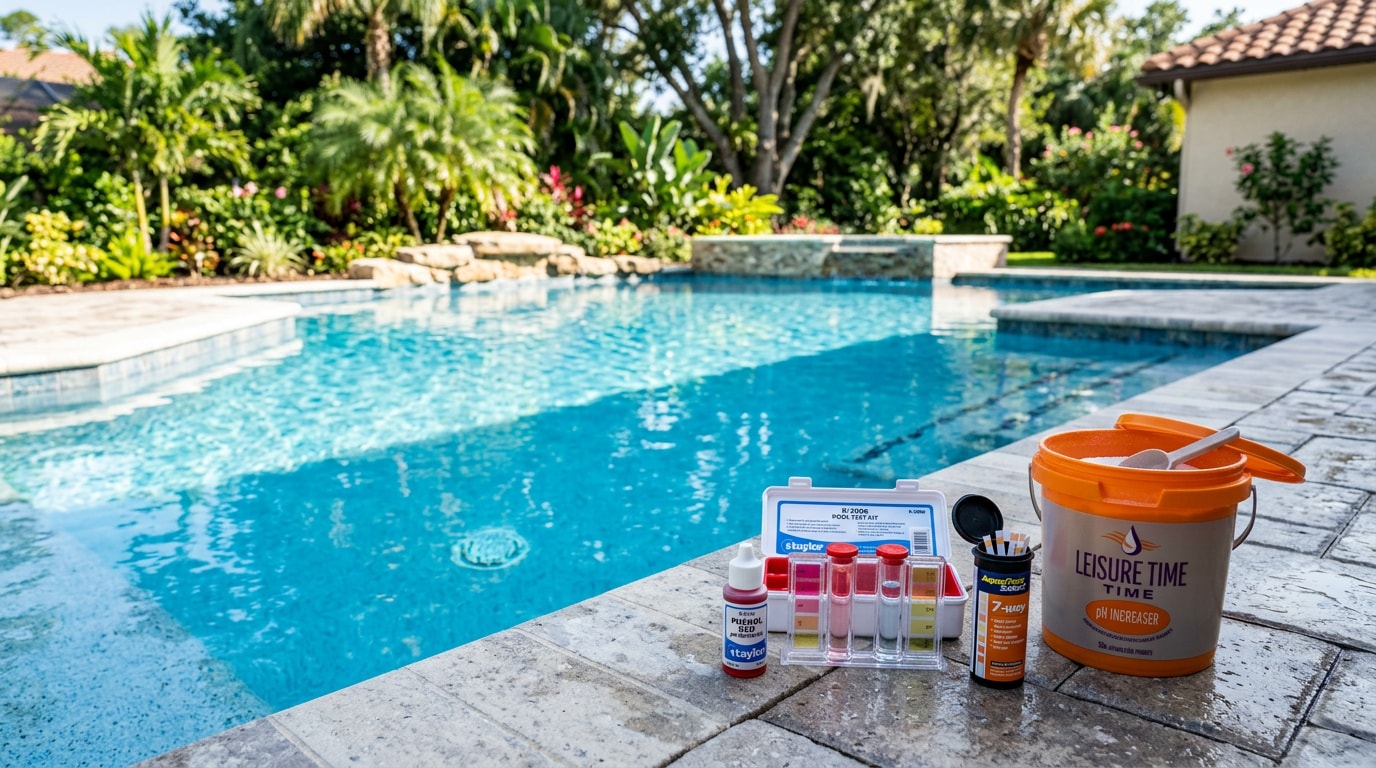
If your test kit keeps landing below 7.2, you need to raise pH in your pool quickly, and Winter Park's rain, heat, and heavy chlorine use make that a near-monthly chore. This guide covers the fastest safe methods, the exact dosing math, and the local conditions that keep pulling your water back down.
Visit Swim Solutions to see our services and request a free estimate.
Quick Answer: The Fastest Way to Raise Pool pH
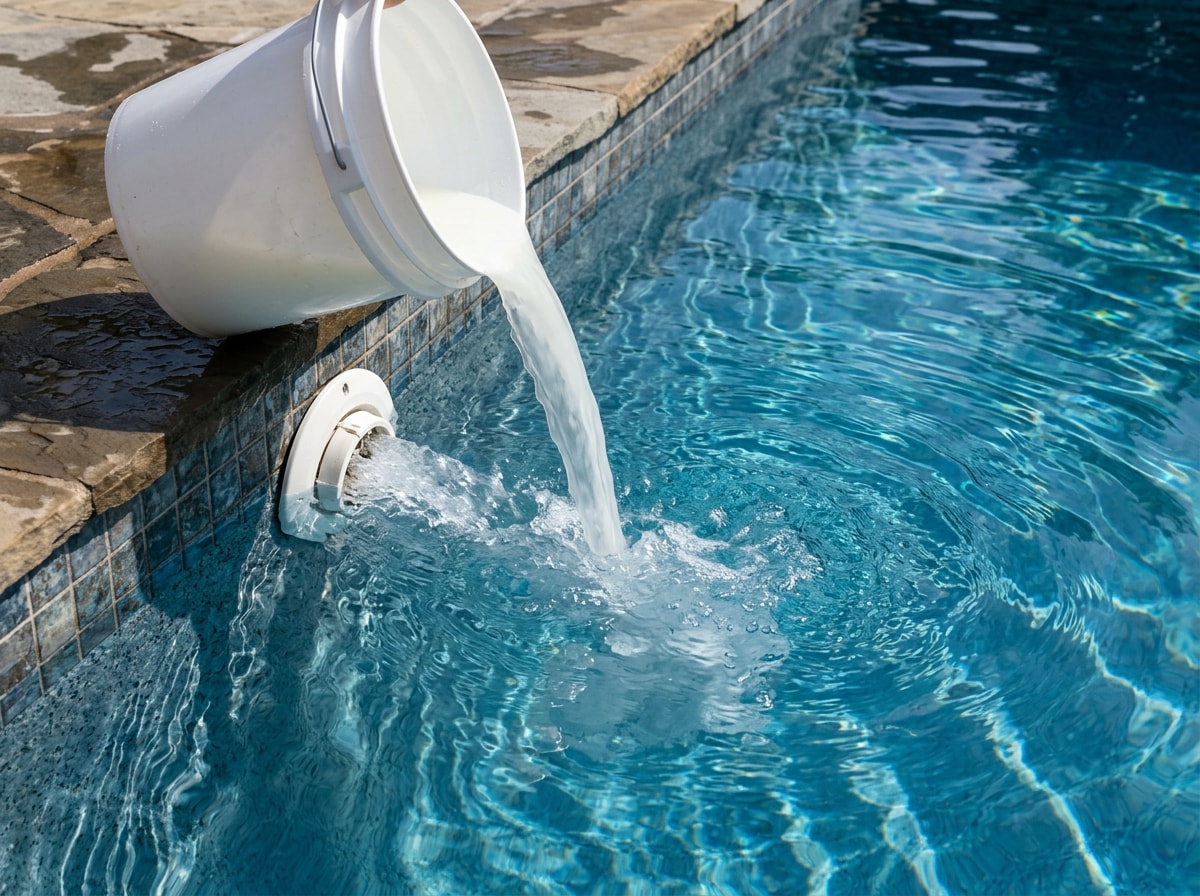
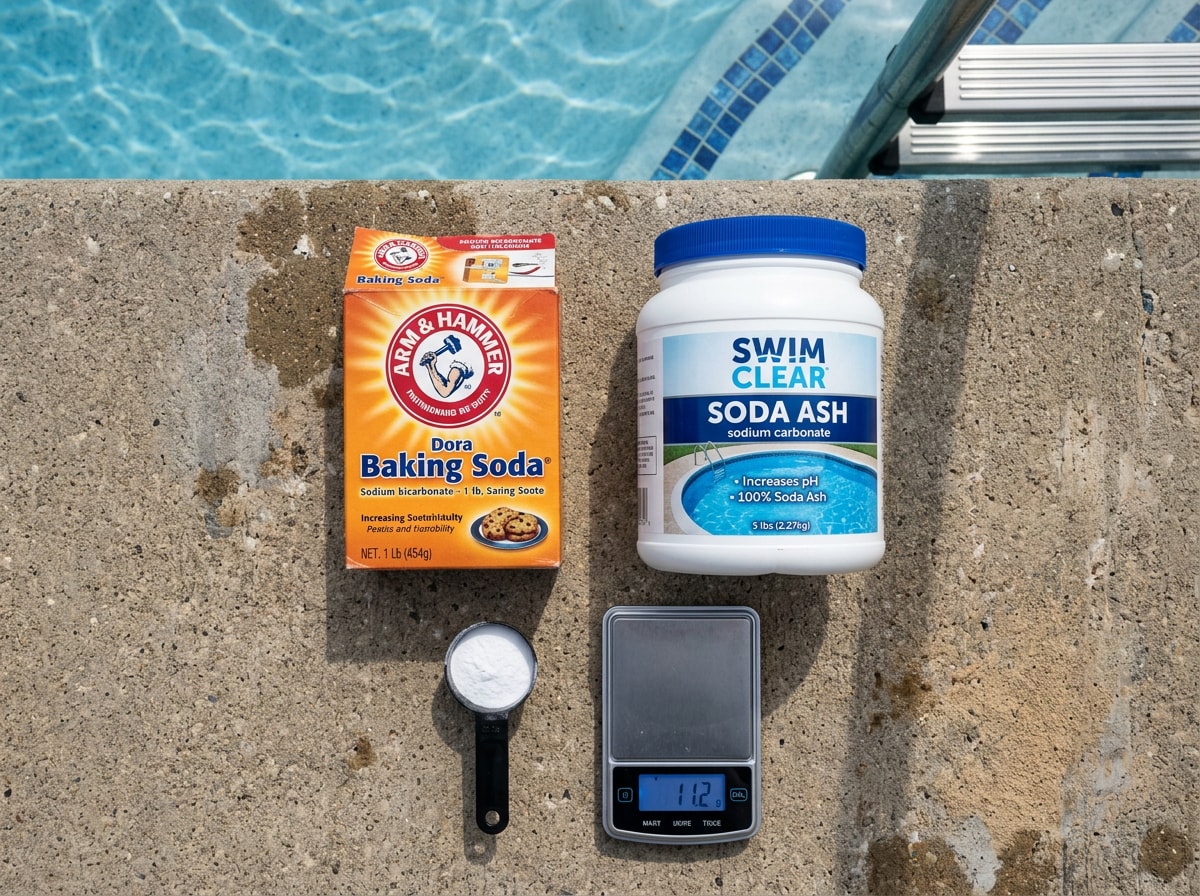
Soda ash (sodium carbonate) raises pH faster than any other product you can safely add yourself. Pre-dissolve it in a bucket of pool water, pour it around the perimeter with the pump running, and retest in four to six hours.
Use baking soda instead only when both pH and total alkalinity are low, since it corrects both numbers at once but moves pH more slowly.
Step-by-Step: Raising Pool pH Quickly
Follow these four steps in order. Skipping the retest is the single biggest reason corrections overshoot.
- Test pH and total alkalinity together. A pH-only reading tells you almost nothing about which product to use.
- Calculate your dose by exact pool volume, not a rough guess. Manufacturer charts assume accurate gallons.
- Pre-dissolve the product in a bucket of water, then pour it slowly near return jets with the pump running.
- Wait several hours, then retest. Smaller repeated doses beat one large dose that risks overshooting into high-pH territory.
Baking Soda vs. Soda Ash: Which One to Use
| Factor | Baking Soda (Sodium Bicarbonate) | Soda Ash (Sodium Carbonate) |
|---|---|---|
| Speed | Slower, gradual rise | Fast, noticeable within hours |
| Effect on alkalinity | Raises it significantly | Minimal effect |
| Best used when | Both pH and alkalinity are low | Alkalinity is normal, pH alone is low |
| Typical dose (10,000 gal) | 3-4 lbs for pH under 7.2 | About 6 oz per 0.2 pH increase |
A pH level less than 7.2 typically calls for 3 to 4 pounds of baking soda per 10,000 gallons of water , while around six ounces of soda ash per 10,000 gallons will raise a pool's pH by about 0.2 . Soda ash is more alkaline than baking soda and raises pH more drastically, while baking soda increases pH more subtly and is less harsh .
Never pour either product straight into the skimmer. Broadcast the pre-dissolved solution across the surface with the pump circulating so it doesn't settle and etch the floor.
Can You Raise Pool pH Without Chemicals?
Yes, through aeration, though it's the slowest method. Aerating the water by turning on water features, pointing return jets upward, or splashing the surface will raise pH over time , and it won't affect alkalinity levels at all . Use this as a touch-up between chemical doses, not as a fast fix when pH has crashed after a storm.
What Is Pool pH, and Why Does It Matter Here?
pH measures how acidic or basic your water is on a 0-14 scale. The CDC recommends keeping pool pH between 7.0 and 7.8 , since levels outside that range make chlorine less effective and irritate swimmers' eyes and skin. Many pool professionals target the tighter 7.2 to 7.8 band for day-to-day comfort and equipment protection.
High pH causes scaling and cloudy water. Low pH corrodes ladders, heaters, and fittings, and it bleaches vinyl liners faster than normal. Both ends produce similar-feeling eye and skin irritation, which is why testing matters more than guessing from symptoms alone.
Signs Your Winter Park Pool's pH Is Too Low
- Stinging eyes and dry, itchy skin after swimming
- Green or brown staining near metal fixtures and ladders
- Visible etching on plaster surfaces
- Chlorine burning off faster than it used to
These signs often show up before a test kit confirms the drop, so a quick look at fixtures and surfaces is worth doing between full water tests.
Why Winter Park Pools Lose pH So Fast
Central Florida's rainy season is the main culprit, and the numbers are specific to this area. June is the wettest month in Winter Park, averaging 5.6 inches of rain , and the wetter season runs roughly four months, from late May to late September, with better than a 41% chance of rain on any given day . Zoom out further and summer is Winter Park's wettest season, averaging 7.8 inches of rain per month against an annual total near 52.3 inches .
Rain is naturally slightly acidic, and that acidity, combined with dilution of your pool's buffering alkalinity, pulls pH down after almost every summer storm. Winter rainfall, by contrast, is light , which is why most Winter Park pools need pH correction far more often from June through September than they do the rest of the year.
In fifteen years of service calls across Orange and Seminole counties, the pattern we see most isn't the storm itself, it's homeowners re-dosing soda ash the next morning without checking alkalinity first. If alkalinity never gets corrected, pH drifts right back down within days, and the "quick fix" turns into three separate chemical purchases instead of one.
Does Pool Shock Raise pH?
It depends on the type. Adding chlorine shock can raise the pH level of your pool water , particularly calcium hypochlorite, while other shock types have little effect. Don't rely on shocking alone to correct a low pH reading.
Common Mistakes That Delay pH Recovery
- Adding a double dose of soda ash after a storm instead of testing alkalinity first
- Dumping dry powder straight into the pool instead of pre-dissolving it
- Skipping the retest window before adding more product
- Chasing pH while ignoring alkalinity, which just causes the next crash
Testing both numbers and correcting alkalinity before pH almost always stabilizes a Winter Park pool in one pass instead of several.
How Often Should You Test Pool pH in Winter Park?
Test two to three times per week under normal conditions, and bump that up to after every significant rain event or pool party during the summer wet season. Higher bather load and rainfall both push pH off balance faster than usual, and catching the drop early keeps the dose small.
Routine water chemistry balancing from a technician who already knows your pool's typical alkalinity baseline makes this step far less guesswork for anyone not excited about testing water twice a week.
When a Persistent Low pH Means a Bigger Problem
If pH keeps slipping despite correct dosing, something else is usually at play, such as surface damage, a corroding heater, or a slow leak constantly introducing fresh, unbalanced water. A full inspection catches these issues before they become expensive repairs.
Schedule a Free Inspection if your pool's pH won't hold steady, or ask about an ongoing pool maintenance plan that keeps testing and dosing on a schedule instead of a guess. We cover pools throughout the Winter Park service area and the surrounding Central Florida communities. If your water tends to swing the other direction, our guide to lowering pool pH walks through that correction too.
Handling chemicals safely matters as much as getting the dose right. OSHA's Hazard Communication Standard requires that the hazards of chemicals be properly classified and communicated to anyone handling them , which is the same reasoning behind wearing gloves and eye protection, keeping products in original labeled containers, and never mixing two chemicals together in one bucket.
FAQ
What is the fastest way to raise the pH of my pool?
Soda ash works fastest, often showing results within four to six hours of full circulation. Retest after that window before adding more, since results can take longer in larger pools or colder water.
Will baking soda raise pH in a pool?
Yes, but pool-grade sodium bicarbonate is formulated for large volumes. It raises pH more gradually than soda ash and also raises total alkalinity, so it's the right call when both numbers are low.
Can I raise pool pH without using chemicals?
Yes, through aeration. Pointing return jets upward, running water features, or increasing surface agitation releases dissolved CO2 and nudges pH up without touching alkalinity. It's slower than soda ash, so save it for minor corrections or as a between-dose touch-up.
Does pool shock raise pH and alkalinity?
It depends on the shock type. Calcium hypochlorite shock can raise pH slightly, while other shock types have minimal effect, so shocking alone isn't a reliable way to correct pH.
What happens if I add too much pH increaser?
Overcorrecting pushes pH too high, causing cloudiness and scaling similar to naturally high pH. Fix it with small doses of pH decreaser, retesting between each addition rather than adding it all at once.