Pool chemistry in Oviedo, FL comes down to four numbers, pH, total alkalinity, calcium hardness, and cyanuric acid, and Central Florida's heat, storms, and hard groundwater knock every one of them out of range faster than most owners expect. Get it wrong and you're looking at cloudy water, scaled tile, or in some cases a closed pool if you manage an HOA or commercial property. This guide lays out the exact target ranges, the local factors that move them, and the order to fix them in.
This guide is maintained by the water chemistry team at Swimm Solutions, who test and balance residential, HOA, and commercial pools across Seminole County. Questions about a specific pool? Contact us directly.
Pool Chemistry Target Ranges for Oviedo Pools
Four parameters drive almost everything else in pool water management, and they interact, so balancing is a sequence, not a single task.
pH
CDC recommends pH 7.0–7.8 and a chlorine concentration of at least 1 ppm in pools and at least 3 ppm in hot tubs . Most pool professionals aim tighter than that bare minimum: the Pool & Hot Tub Alliance lists pH with a minimum of 7.2, an ideal range of 7.4–7.6, and a maximum of 7.8 for all pool types.
The practical reason to stay inside that band is chlorine performance. Keeping the pH in the 7.0–7.8 range best balances killing germs to prevent swimming-related illness, the lifespan of the pipes, and swimmers' comfort, and as pH goes up, the ability of chlorine to kill germs decreases, especially if pH is above 8.0 . On the low end, as pH goes down, especially below 7.0, the ability of chlorine to kill germs increases but pool and hot tub pipes are more likely to corrode or break down .
Total Alkalinity (TA)
Total alkalinity buffers pH so it doesn't swing every time rain, bather load, or a chemical addition hits the water. Most pool professionals target 80-120 ppm, with commercial pools often held toward the middle of that band for stability. Oviedo's groundwater tends to run alkaline to start, so a new fill or a heavy top-off often needs a TA check before anything else gets adjusted. Skipping that step is one of the more common reasons pH "won't hold" no matter how often it's corrected.
Calcium Hardness (CH)
Calcium hardness has to sit in a middle zone. PHTA's reference table puts calcium hardness at a minimum of 150, an ideal range of 200–400, and a maximum of 1,000 ppm for pools and waterparks . Too low and water turns aggressive toward plaster and metal fittings; too high and it deposits as scale on tile, equipment, and heater elements.
Florida's groundwater is part of the reason this matters here more than in some other markets. Much of Florida's well water is alkaline, running pH 7.6 to 8.5 , and that same geology tends to carry elevated calcium and magnesium. Pools filled or topped off with that water often arrive already running toward the upper end of the calcium range, which makes periodic testing worth doing rather than skipping.
Cyanuric Acid (CYA) / Stabilizer
Cyanuric acid, or stabilizer, shields chlorine from rapid UV breakdown. Without it, outdoor chlorine in Florida sun can burn off within a couple of hours. PHTA's guideline keeps cyanuric acid in the 30–50 ppm range for all pool types . Too much CYA causes "chlorine lock," where chlorine is technically present but too shielded to sanitize effectively. If you run stabilized chlorine products like dichlor or trichlor, CDC recommends a chlorine concentration of at least 2 ppm in pools rather than the 1 ppm baseline, since CYA reduces chlorine's killing power at any given concentration.
How CDC, PHTA, and Florida Code Numbers Actually Compare
Most pool guides quote one authority and stop there. Here's how the three sets of numbers that actually govern an Oviedo pool line up side by side:
| Parameter | CDC (public health minimum) | PHTA (ideal operating range) | Florida 64E-9 (public pool enforcement) |
|---|---|---|---|
| pH | 7.0–7.8 | 7.2 min / 7.4–7.6 ideal / 7.8 max |
Pool must be closed by the department if pH is below 7.2 or above 7.8
| Free Chlorine |
Minimum 1 ppm, pH held 7.0–7.8
| 1.0 min / 2.0–4.0 ideal / 5.0 max |
Closure triggered if disinfectant level is below minimum or above maximum prescribed in code
| Calcium Hardness | Not addressed | 150 min / 200–400 ideal / 1,000 max | Varies by plaster type |
| Cyanuric Acid | Avoid in hot tubs | 30–50 ppm | Often capped lower for commercial systems |
The takeaway: a pool can satisfy the CDC's bare public-health minimum and still fail a Florida inspection or grow algae, because the state's enforcement thresholds and PHTA's "ideal" targets are both stricter than the federal baseline.
Why Oviedo's Climate and Hard Water Push These Numbers Around
Heat, intense UV, and heavy seasonal rain all accelerate chemical consumption here, while Oviedo's alkaline groundwater raises the baseline for calcium and alkalinity before a pool owner even opens a test kit. Sun breaks down unstabilized chlorine quickly, and rain dilutes alkalinity and sanitizer at the same time it washes debris into the water.
The seasonal swing is real and worth planning around. A summer week in Oviedo typically brings daily "very high" UV plus one or two heavy rain events, either of which can drop free chlorine and dilute alkalinity enough to require mid-week rebalancing. A winter week sees lower UV load and far less rain, so the same pool might hold stable chemistry for ten days or more. That gap is the main reason test frequency should flex with the season rather than stay fixed year-round.
Testing and Balancing Order: The Checklist
A reliable routine follows a specific sequence. Balancing out of order means one adjustment can undo another, since alkalinity and pH are interdependent while calcium and sanitizer respond more predictably once the first two are stable.
- Test total alkalinity and adjust toward 80-120 ppm.
- Test and adjust pH into the 7.4-7.6 ideal window.
- Check calcium hardness and adjust if scaling or corrosion risk is present.
- Test and dose chlorine or sanitizer based on current demand.
- Check cyanuric acid and phosphate levels periodically, not just when a problem shows up.
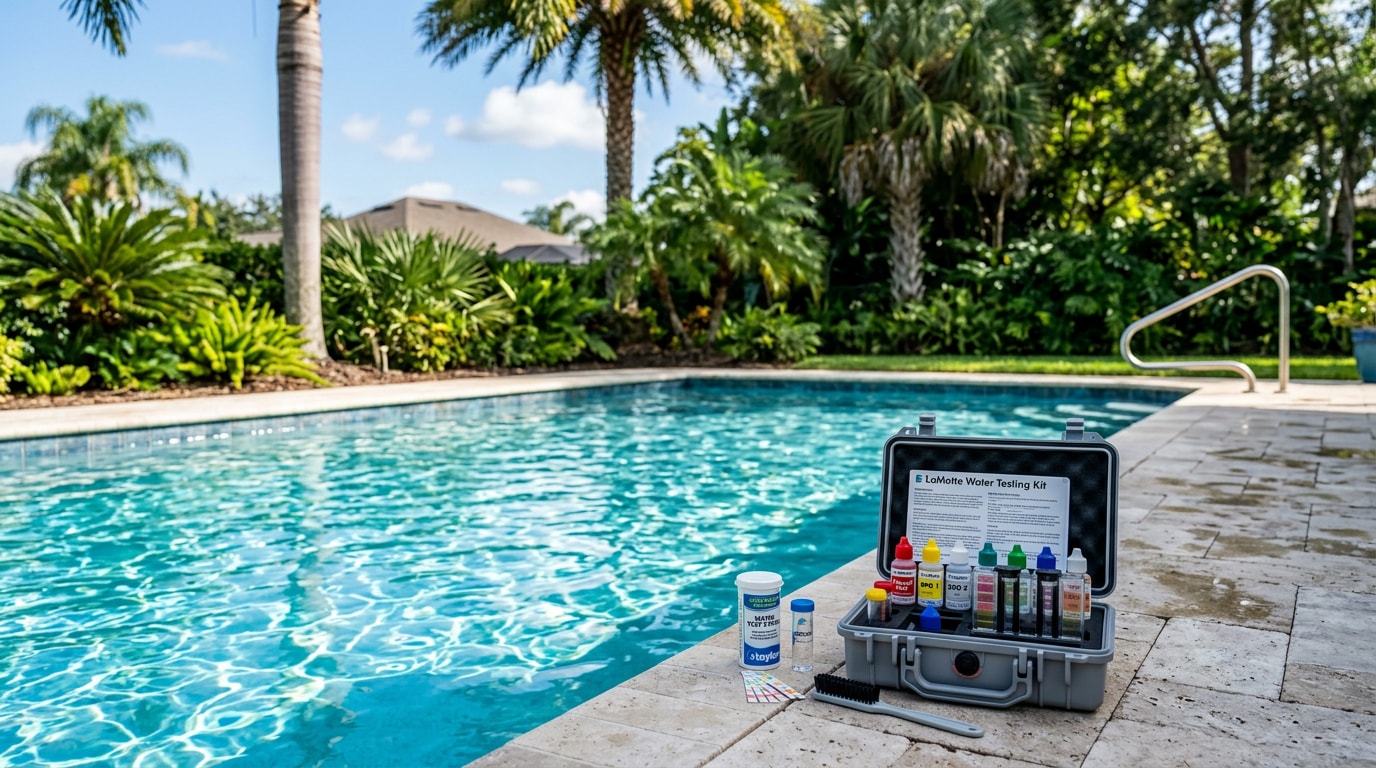
A couple of misconceptions deserve pushback. "More chlorine always fixes algae" isn't reliable, if phosphate levels are high or pH is out of range, extra chlorine gets consumed without ever clearing the bloom. Test strips are convenient but not precise enough for calcium hardness or CYA readings, where a liquid or digital kit gives more dependable numbers. For the full PHTA dosing-sequence standard, see PHTA's pool chemicals guidance. If you'd rather hand this off entirely, a professional water chemistry balancing service takes the guesswork out of order and dosage.
Residential vs. Commercial Standards in Oviedo
Not every pool answers to the same rulebook. A private backyard pool and a pool attached to an apartment complex or HOA clubhouse follow different standards, and that distinction matters before you assume your readings need to match a commercial checklist.
The Florida Department of Health regulates all public pools and bathing places as defined in Chapter 64E-9 of the Florida Administrative Code , and in Seminole County that enforcement runs through the local Department of Health office. The "public" or "semi-public" classification comes from permit category, not pool size, a small clubhouse pool can still be regulated as commercial. Residential single-family pools fall outside that inspection framework, though they remain subject to local Development Services requirements whenever structural or equipment modifications are involved.
| Parameter | Residential Target | Commercial Target (Ch. 64E-9) |
|---|---|---|
| pH | 7.2-7.8 | 7.2-7.8, closure triggered outside this band |
| Total Alkalinity | 80-120 ppm | 60-180 ppm, varies by sanitizer type |
| Calcium Hardness | 200-400 ppm | 200-1,000 ppm, plaster-dependent |
| Cyanuric Acid | 30-50 ppm | Often capped lower or restricted |
Property managers overseeing a permitted facility should review commercial pool service standards before assuming residential guidance applies, since inspection frequency and recordkeeping differ substantially. More detail on local enforcement is available from the Florida Department of Health in Seminole County.
New Construction, HOA, and First-Time Owner Challenges
Oviedo's newer neighborhoods create startup-chemistry and appearance-standard challenges that older pool markets deal with less often. Many pools in the 32765 and 32766 zip codes are recent builds, which means fresh plaster, new salt chlorination systems, and owners encountering pool chemistry for the very first time.
Phosphates and Oviedo's Wildlife
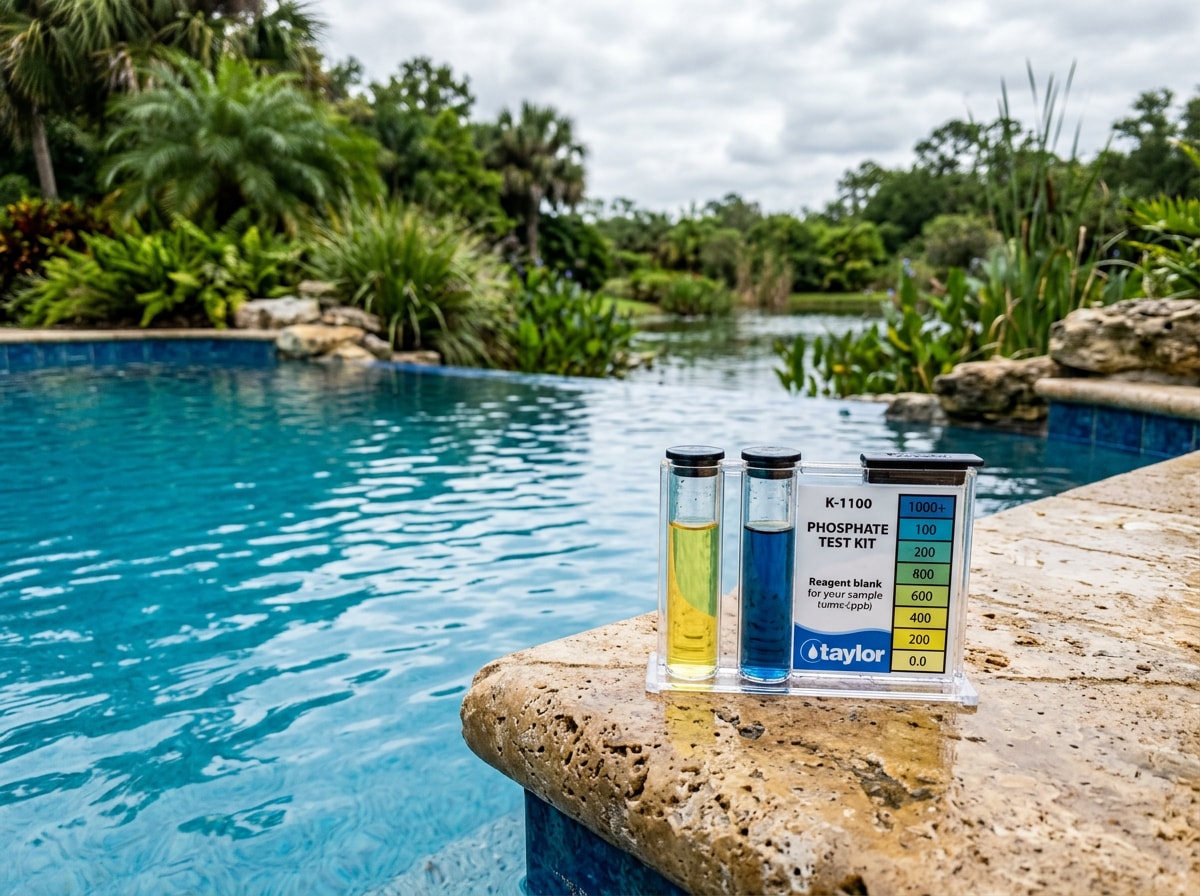
Oviedo is well known regionally for its feral chicken population, especially around the Oviedo Mall corridor and historic downtown. Those birds forage across lawns, retention pond banks, and pool decks, and their droppings wash into pools during the next rain or deck rinse. Phosphates themselves don't sanitize or harm swimmers directly, the issue is that phosphate acts as a nutrient source for algae, not something chlorine neutralizes on its own.
Many pool professionals treat phosphate readings above roughly 500 ppb as the point where algae starts outpacing standard chlorine dosing, even when sanitizer levels look fine on paper. That's why phosphate testing belongs in every routine visit rather than as an occasional extra step. A practical workflow: test phosphates at each visit, apply a phosphate remover if readings climb into that range, then confirm chlorine and pH are both in order before assuming an algae issue is resolved. Treating only the algae without addressing phosphate tends to bring the problem back within days.
HOA Appearance Standards
HOA communities throughout Oviedo and Seminole County maintain strict appearance standards, especially for pools near retention ponds where wildlife-driven phosphate loads run higher than average. Falling behind on this one parameter is a common reason an otherwise well-balanced HOA pool still develops visible algae between service visits. Consistent weekly pool cleaning keeps these readings from drifting between stops, and if equipment is struggling to keep pace, a pool equipment repair visit can rule out a circulation problem before you assume it's purely a chemistry issue.
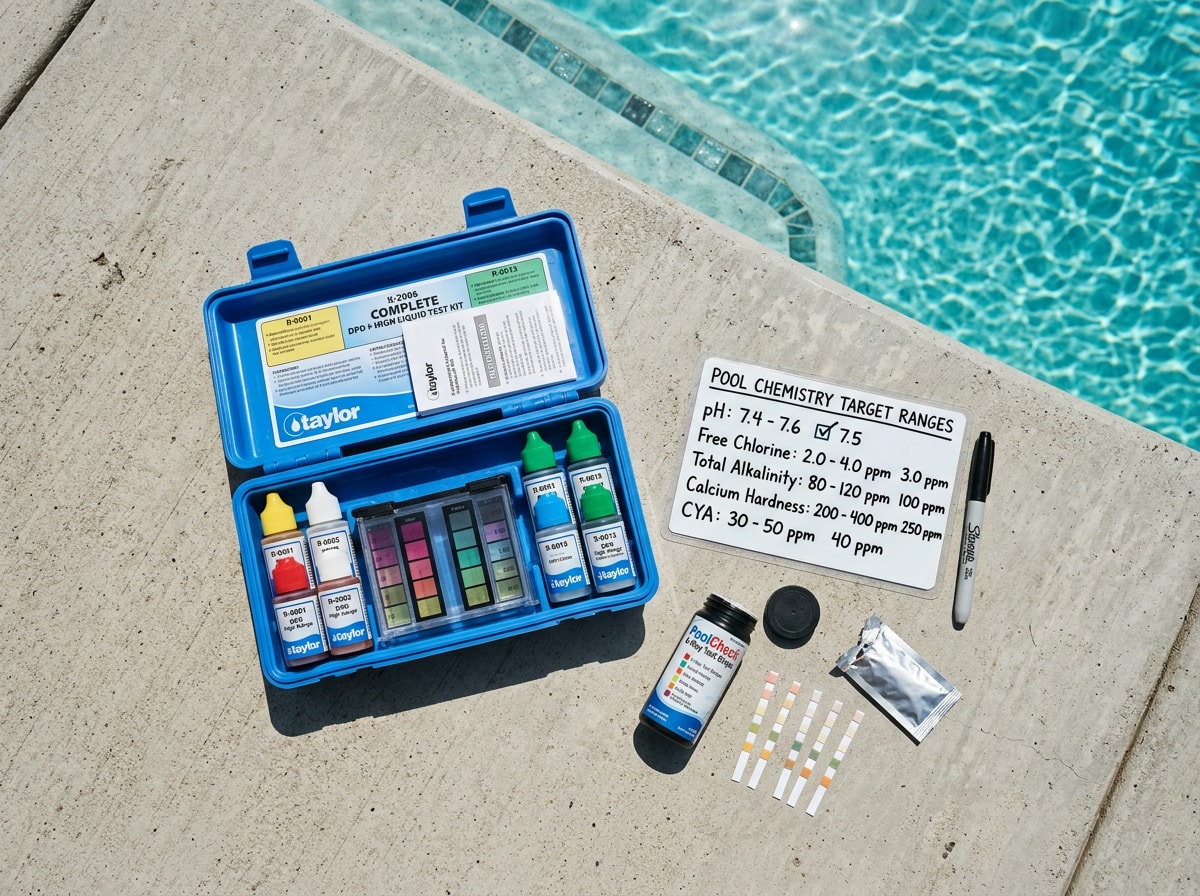
Pool Chemistry Target Reference Table
These ranges are starting points, not universal guarantees, plaster type, sanitizer method, and local water conditions can all shift the ideal number slightly.
| Parameter | Residential Target | Why It Matters in Oviedo |
|---|---|---|
| pH | 7.4-7.6 ideal | Alkaline groundwater pushes pH up over time |
| Total Alkalinity | 80-120 ppm | Buffers pH against rain and bather load swings |
| Calcium Hardness | 200-400 ppm | Hard local water starts many pools near the upper end |
| Cyanuric Acid | 30-50 ppm | Protects chlorine from intense Florida UV |
| Phosphates | Below 500 ppb | Local wildlife and runoff add a steady phosphate load |
Chemical Balancing as Part of a Weekly Maintenance Plan
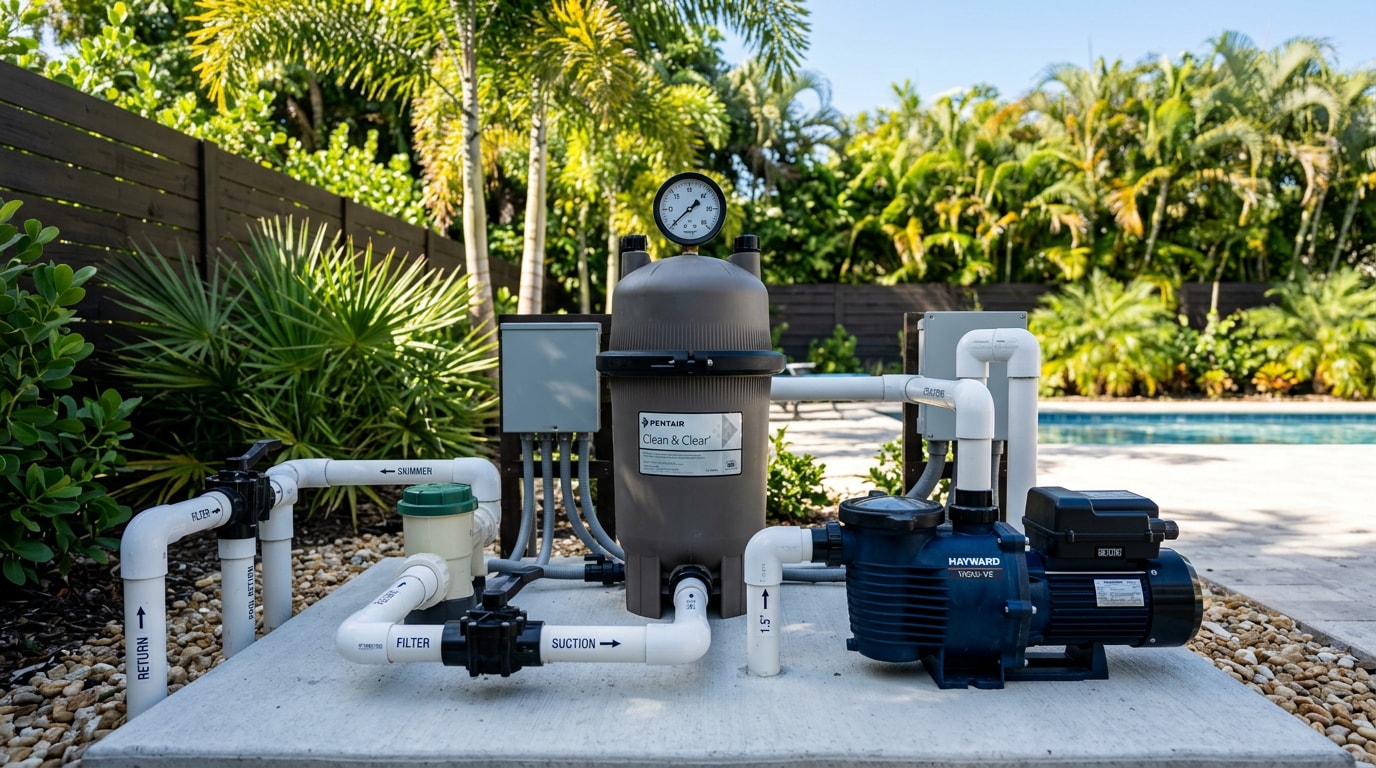
A typical weekly visit covers chemical testing and balancing, algae treatment where needed, and filter cleaning or backwashing to keep circulation efficient. Each task ties back to the parameters above, a filter that isn't backwashed regularly makes phosphate and debris problems worse even when the chemistry numbers look fine on paper. If your filter media is reaching the end of its service life, our guide to pool filter cartridges in Winter Springs walks through cleaning intervals and replacement signs that apply equally well in Oviedo.
A proper weekly visit should include a full chemistry check calibrated to Oviedo's hard water and debris cycles, along with documentation of readings and equipment status after each stop, that record matters most for HOA and commercial accounts during an inspection or dispute. For ongoing care rather than a one-time fix, pool maintenance plans keep testing on a fixed schedule instead of a reactive one. See our full Oviedo, FL service area page for coverage details, or visit the Swimm Solutions homepage for the full list of services. Ready for someone else to carry the test kit? Get a free estimate and we'll put together a chemistry and maintenance plan for your pool.
FAQ
How often should I test my pool water?
Test two to three times per week during Oviedo's hot, rainy summer months, when UV exposure and storms burn through chlorine and dilute alkalinity fast. In cooler, drier winter weeks, once or twice a week is usually enough unless the pool sees heavy bather use.
Why is my pool water cloudy?
Cloudiness usually traces back to low chlorine, pH or alkalinity drifting out of range, or calcium hardness climbing high enough to cause fine scale particles suspended in the water. Testing all four core parameters together, rather than guessing at one cause, finds the culprit faster.
What should my pool's pH be?
Keep pH between 7.4 and 7.6 for the best balance of swimmer comfort and chlorine effectiveness. Outside that window, either eye irritation or reduced sanitizer performance becomes more likely.
What is the correct order to balance pool chemicals?
Balance total alkalinity first, then pH, then calcium hardness, and dose sanitizer last. This sequence keeps earlier adjustments from being undone by later ones.
Does Oviedo's hard water affect my pool chemistry?
Yes. Central Florida groundwater runs alkaline and mineral-heavy, so pools filled or topped off locally often start with elevated alkalinity and calcium hardness before any chemicals are added. Testing both before assuming your pool needs acid or scale treatment avoids over-correcting.
What causes high phosphates in Oviedo pools?
Local wildlife droppings, fertilizer runoff near retention ponds, and tap water itself can all introduce phosphates. They don't sanitize or harm swimmers directly, but they feed algae growth that outpaces normal chlorine levels once readings climb too high.
Are residential pools in Oviedo inspected by the health department?
No. Single-family residential pools fall outside Florida's Chapter 64E-9 inspection framework. HOA, hotel, apartment, and other pools open to more than one household are classified as public or semi-public and are subject to Florida Department of Health inspection.