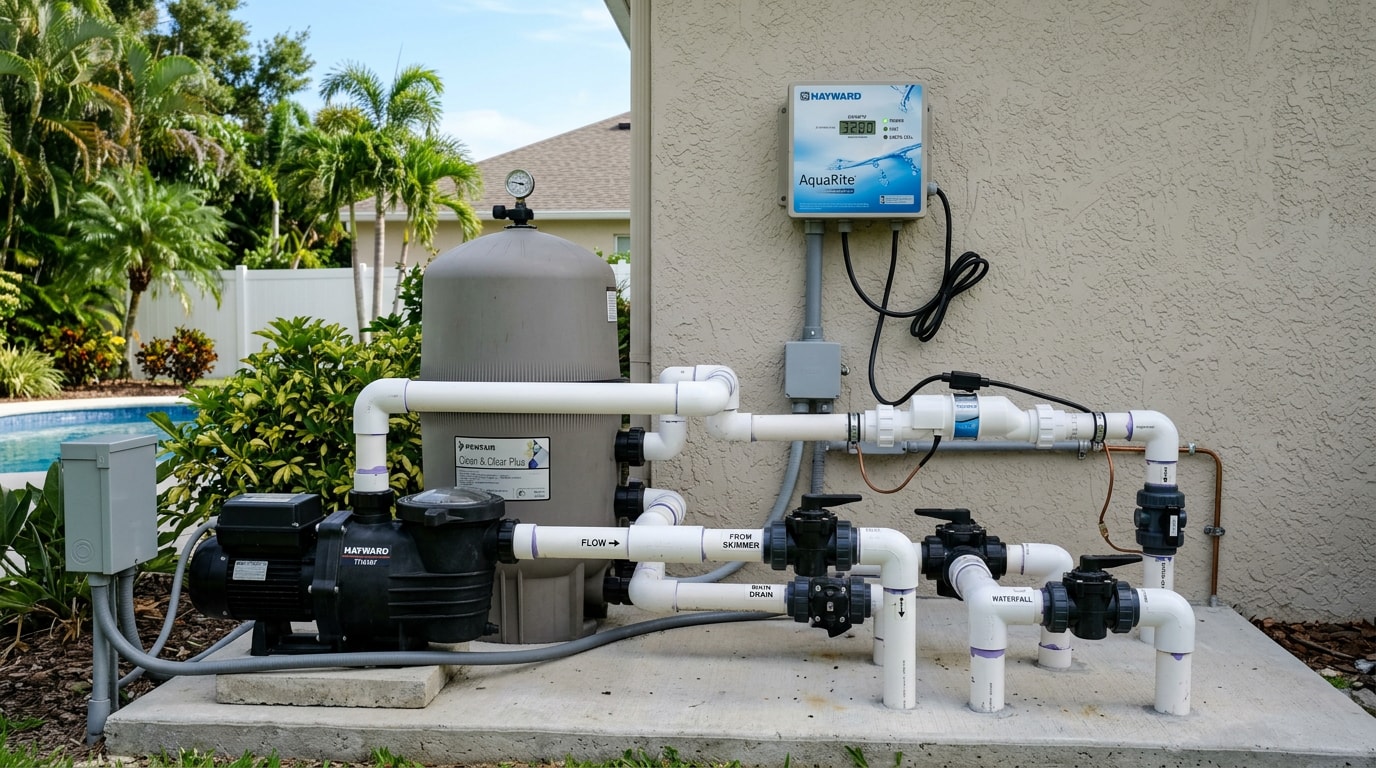
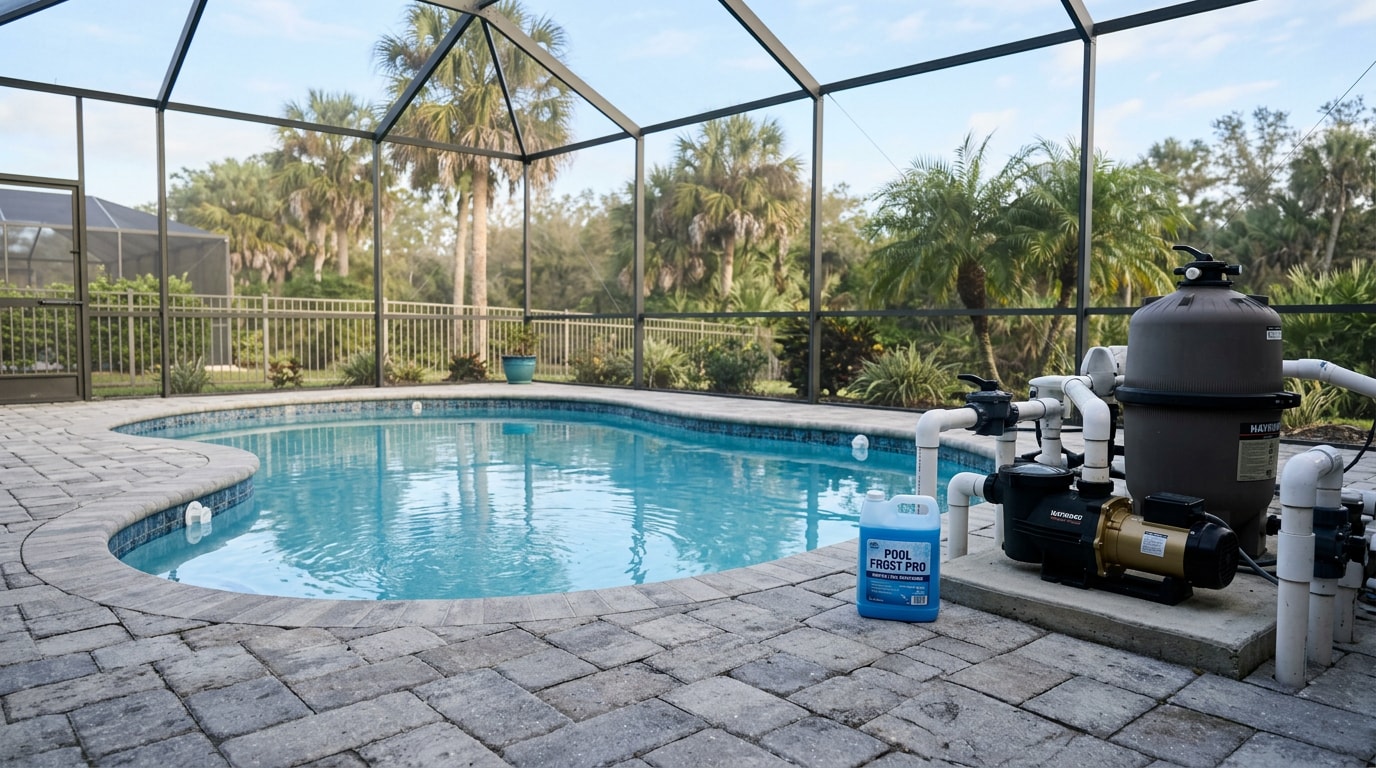
Pool antifreeze in Lake Mary, FL only matters a handful of nights a year, but those nights can crack a return line in hours if your plumbing isn't ready. This guide covers whether you actually need it, how much to buy, and the full winterizing process local pools go through before a cold snap. By the end, you'll know exactly what to do the next time a freeze warning hits Seminole County.
Do You Really Need Pool Antifreeze in Lake Mary?
Short answer: probably not every year, but you need to own some anyway. NOAA climate normals show the greater Orlando area, which includes Lake Mary, averages only one to two nights a year at or below 32°F. Most winters pass without a single hard freeze touching pool plumbing.
That doesn't mean you can ignore it. The National Weather Service issues a freeze warning whenever temperatures are <a>expected to drop to 32°F or below for a long enough period</a> to threaten crops, plants, and outdoor plumbing, and Central Florida gets at least one or two of these alerts most winters. When that warning shows up, water sitting in an exposed skimmer line can freeze and crack a fitting in a single overnight event.
A Freeze Warning is issued when temperatures are forecasted to go below 32°F for a long period of time. That's the trigger point Lake Mary homeowners should watch for, not a date on the calendar.
So the realistic approach here is situational readiness: keep a bottle of pool-grade antifreeze on hand, know your winterizing steps, and act fast when the forecast turns. You don't need a Michigan-style closing routine. You need a plan you can execute in an afternoon.
Pool Antifreeze vs. Automotive Antifreeze: Why the Difference Matters
Never use automotive antifreeze in or near a swimming pool. Automotive antifreeze is made from ethylene glycol, a chemical that's toxic to people and pets even in small amounts. Pool-grade antifreeze uses propylene glycol instead, a different compound that's non-toxic and safe for the plumbing it's designed to protect.
This isn't a minor technicality. The CDC's toxicology profile on ethylene glycol confirms that ethylene glycol and propylene glycol are clear liquids used in antifreeze and deicing solutions, and exposure to large amounts of ethylene glycol can damage the kidneys, heart, and nervous system . Pool antifreeze doesn't carry that risk because it's built from a completely different, food-grade chemical.
The safest way to avoid mixing the two up is to buy antifreeze from a pool supply retailer rather than an auto parts counter. The labels can look similar at a glance.
| Feature | Pool Antifreeze | Automotive Antifreeze |
|---|---|---|
| Chemical type | Propylene glycol | Ethylene glycol |
| Toxicity | Non-toxic | Highly toxic |
| Approved use | Pool and RV plumbing | Vehicle cooling systems |
| Typical cost | $8 to $20 per gallon | Not applicable to pools |
When Should You Close Your Pool for Winter?
Lake Mary rarely sees sustained freezes, so timing should hinge on the forecast, not a fixed date. Water temperature is the better signal than falling air temperatures alone.
Go By Water Temperature, Not the Calendar
Close your pool when the water consistently stays below 65°F in the mid-afternoon, with closer to 60°F being even safer. Closing too early has its own cost: warm water eats through winterizing chlorine within weeks, so a pool closed above 65°F often opens green in spring.
Beyond chemistry, there's a mechanical deadline too. Close before the first hard freeze in your forecast, since standing water in pipes and equipment can crack them once temperatures drop.
What To Do If a Freeze Warning Catches You Off Guard
Most Lake Mary pool owners won't have fully winterized by the time the season's first freeze warning hits. If that happens to you, run the pump continuously overnight. Moving water doesn't sit still long enough to freeze in the pipes, even when air temperatures dip into the 20s.
We've answered emergency calls in Lake Mary where a homeowner shut the pump off before bed on a freeze-warning night, not realizing the system's auto freeze-protect setting had been switched off months earlier. Check that setting now, before you need it, so the pump kicks on by itself if a cold front sneaks up.
Complete Pool Winterizing Supplies Checklist
Gather everything up front so you're not making a mid-project run to the pool store.
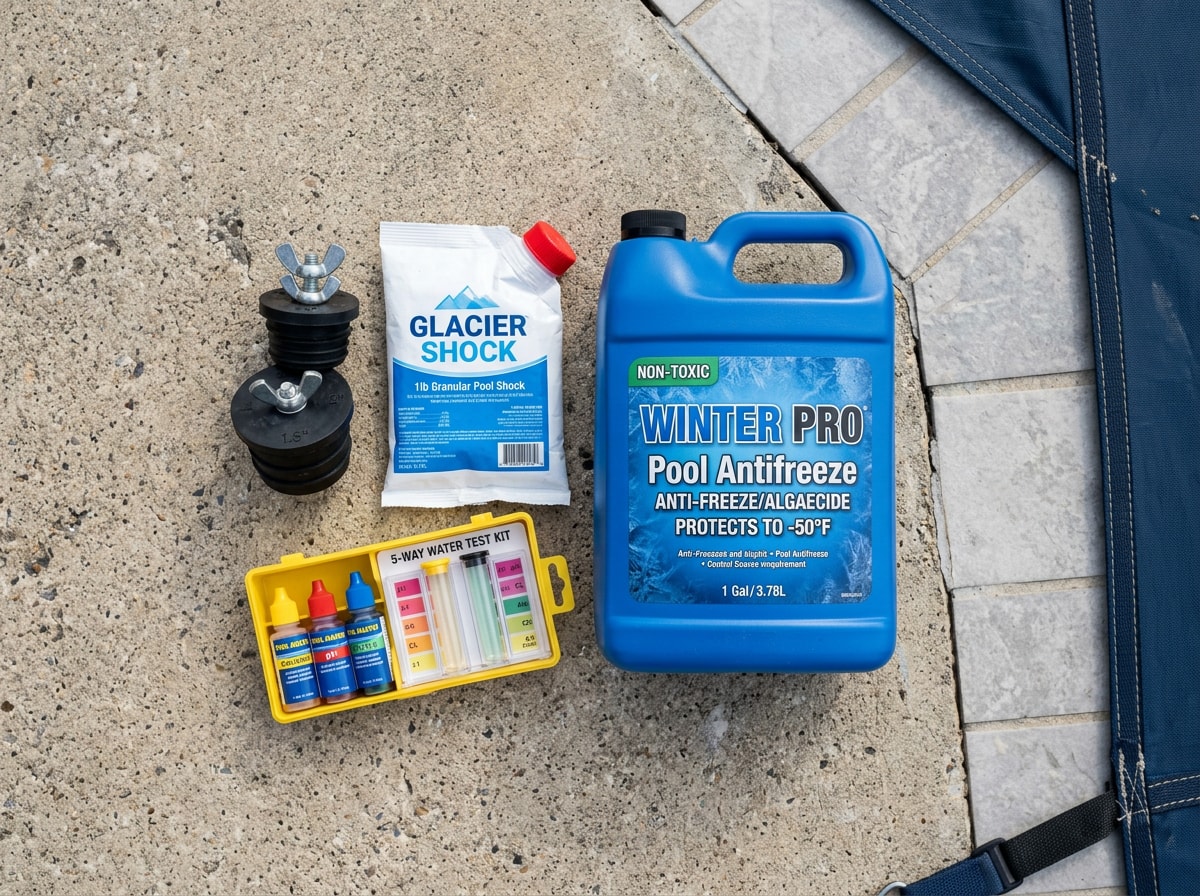
- Closing chemical kit: shock, algaecide, and stain/scale preventer bundled together
- Pool antifreeze (non-toxic propylene glycol) for lines that can't be fully blown out
- Winterizing plugs (rubber expansion plugs) for skimmers and return lines
- Air compressor or shop vac to blow out the lines
- Winter pool cover sized correctly to your pool
Your water chemistry should also be dialed in the same week you close, before you add any shock or algaecide. Starting with balanced water keeps those closing chemicals from reacting unpredictably. Our water chemistry balancing team handles this step for homeowners who'd rather not juggle test strips the week before a cold front.
Balancing Pool Water Chemistry Before Closing
| Parameter | Target Range | Why It Matters |
|---|---|---|
| pH | 7.2–7.6 | Prevents metal corrosion and plaster etching |
| Total alkalinity | 80–120 ppm | Stabilizes pH so it doesn't swing while the pool sits unused |
| Calcium hardness | 200–400 ppm | Avoids plaster deterioration on one end, scaling on the other |
| Free chlorine | 1–3 ppm | Sets a clean baseline just before shocking |
Adjust in order: alkalinity first, then pH, then calcium hardness. Each one affects the others, so sequencing matters more than most people expect.
A closed pool sits untouched for months. Water that's out of balance will quietly corrode fittings or deposit scale on surfaces the entire time, and you won't notice until you pull the cover in spring.
Add Shock and Winterizing Chemicals
A strong chemical dose at closing has to create a barrier that lasts through winter with nobody watching it. Add roughly twice your normal shock dose using cal-hypo, then let it circulate overnight before adding anything else.
Winterizing algaecide is a different product than the one you use in summer. It's a concentrated formula built for three to six months of protection. Dose at 8 to 16 ounces per 10,000 gallons, roughly double the usual summer amount.
Stain and scale preventer rounds out the kit. Calcium can precipitate out of solution as crusty white deposits on surfaces and equipment over the winter, and a sequestrant keeps that from happening even in Central Florida's naturally hard water.
Lower the Water Level
Above-ground and inground pools need different handling here.
- Above-ground pools: Lower the level only slightly, just below the return jet fitting. Draining too much can let the liner shrink, crinkle, or pull away from the wall.
- Inground pools: Bring the level down about 4 to 6 inches below the skimmer opening. This gives the blow-out process room to work and keeps the skimmer housing away from any freezing or expanding water.
Winterizing the Plumbing Lines
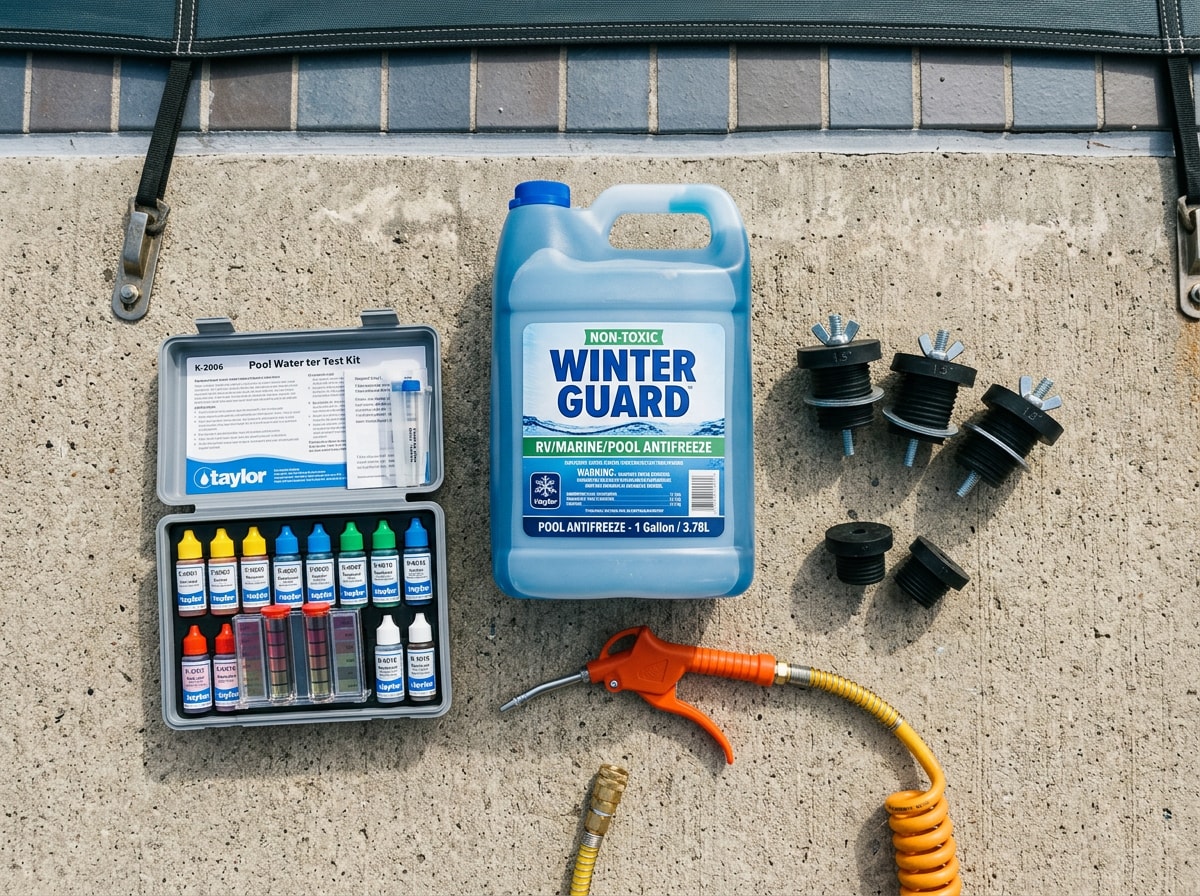
Once the water level is set, clear the lines themselves, the mechanical step that antifreeze ultimately backs up. Blow out each line with compressed air and install an expansion plug immediately while air is still flowing. Don't wait: water trickles back in within seconds if the plug goes in late. Repeat for every suction and return line. Most residential pools have two to four return lines total.
How Much Pool Antifreeze Do You Actually Need?
Antifreeze is backup insurance for whatever water the blow-out couldn't fully clear, not a replacement for it. Industry suppliers generally recommend about one gallon per 10 feet of 1.5-inch pipe, which works out to the ranges below for a typical home system.
| Pool Size | Typical Lines | Antifreeze Needed | Approx. Cost |
|---|---|---|---|
| Small (under 15,000 gal) | 2–4 lines | 1–2 gallons | $16–$32 |
| Medium (15,000–25,000 gal) | 4–6 lines | 2–4 gallons | $32–$64 |
| Large / with spa (25,000+ gal) | 6+ lines | 4–6 gallons | $64–$120 |
For a typical Lake Mary home pool with a standard two-to-four-line setup, that works out to roughly a half-gallon to two gallons of antifreeze total, well within what a single 1-gallon jug covers with some left over.
Applying Antifreeze the Right Way
Apply antifreeze only after the plumbing blow-out is complete, never before. Pour it directly into skimmer and return lines, using roughly 1 to 2 quarts per line depending on length, then install winterizing plugs right away so it can't drain back out. Pour antifreeze into an open, unplugged line and it will simply run out the other end, leaving your pipes with zero protection.
Storing and Disposing of Leftover Antifreeze Safely
Store any leftover antifreeze in its original, clearly labeled container, away from kids, pets, and food storage areas. Propylene glycol itself carries a long safety record. The CDC notes that the FDA has classified propylene glycol as "generally recognized as safe," which means that it is acceptable for use in flavorings, drugs, and cosmetics, and as a direct food additive . That safety profile is exactly why it's the right chemical for pool plumbing and the wrong thing to confuse with automotive antifreeze.
Dispose of empty containers according to local waste guidelines rather than pouring remnants down a storm drain. Being non-toxic doesn't mean it belongs in soil or waterways in bulk quantities.
When to Call a Lake Mary Pool Pro Instead of DIY
Winterizing is a fine DIY project for a straightforward pool with simple plumbing. It gets more complicated fast if you have a spa spillover, an in-floor cleaning system, or equipment that's already showing wear. A line that doesn't fully drain because of a hidden low spot or a collapsed check valve won't protect itself just because you poured antifreeze into it.
If you're not confident the blow-out got everything, or your pump has been making noise all season, it's worth having someone look at it before the cover goes on. Our team handles pool equipment repair and pool maintenance for homeowners throughout Lake Mary and Seminole County, and freeze damage that goes unnoticed over winter is one of the more common reasons we get called out in early spring. If a cracked line already damaged your pool's surface, our replastering cost guide for Lake Mary breaks down what that repair typically runs.
Get a free estimate if you'd rather have a licensed technician close your pool correctly the first time. You can also visit our homepage to see the full range of pool services we offer across Central Florida.
FAQ
Do I actually need pool antifreeze if I live in Lake Mary, FL?
You need to own some, but you won't use it every year. Lake Mary sees freezing temperatures on only a night or two in a typical winter. Keep a gallon on hand and use it whenever a freeze warning is issued, rather than as part of an annual, guaranteed closing routine.
Can I use antifreeze in my swimming pool water?
No. Despite the name, pool antifreeze isn't meant for the pool itself. It would take far more than a gallon jug to meaningfully protect that much water from freezing. Pool antifreeze is for the pipes, not the pool.
Will swimming pool antifreeze harm the pool water?
No. Pool-grade antifreeze is formulated to be non-toxic, so trace amounts that end up in the pool won't harm swimmers or throw off your water chemistry.
How much pool antifreeze do I need for my pool?
Plan on about one gallon per 10 feet of 1.5-inch pipe. Most residential pools with two to four lines need between a half-gallon and two gallons total, which is why a single 1-gallon jug usually covers one closing with extra to spare.
Should I pour pool antifreeze into the skimmer after plugging it?
A cleaner method many pool pros use is pouring antifreeze into an empty winter algaecide bottle, filling it about one-third full, capping it, and dropping the sealed bottle into the skimmer. This keeps the antifreeze contained rather than loose in the skimmer well.
Can I close my pool without an air compressor?
For above-ground pools with simple plumbing, you can often disconnect and gravity-drain the hoses, then add antifreeze to the lines as backup. For inground pools, a compressor is close to essential. A shop vac set to blow mode can work in a pinch, but it's far less reliable at fully clearing longer runs.
How much does it cost to winterize a pool in Lake Mary?
Complete winterization typically runs $50 to $150 in supplies if you DIY, which is far cheaper than treating an algae bloom later. Antifreeze itself is a smaller piece of that total, usually $16 to $120 depending on how much your plumbing needs. Hiring a local pool service costs more upfront but covers the labor and judgment calls that keep a freeze from turning into a repair bill.
---
About the author: This guide was written by the service team at Swimm Solutions, a Certified Pool Operator-led pool contracting and maintenance company serving Lake Mary, Seminole County, and the greater Orlando area. Our technicians close and reopen pools throughout Central Florida every winter and handle the freeze-damage repairs that follow when a line wasn't protected in time. Questions about your specific setup? Contact us for a free estimate.